Don’t wait for the breach
to read the signal.
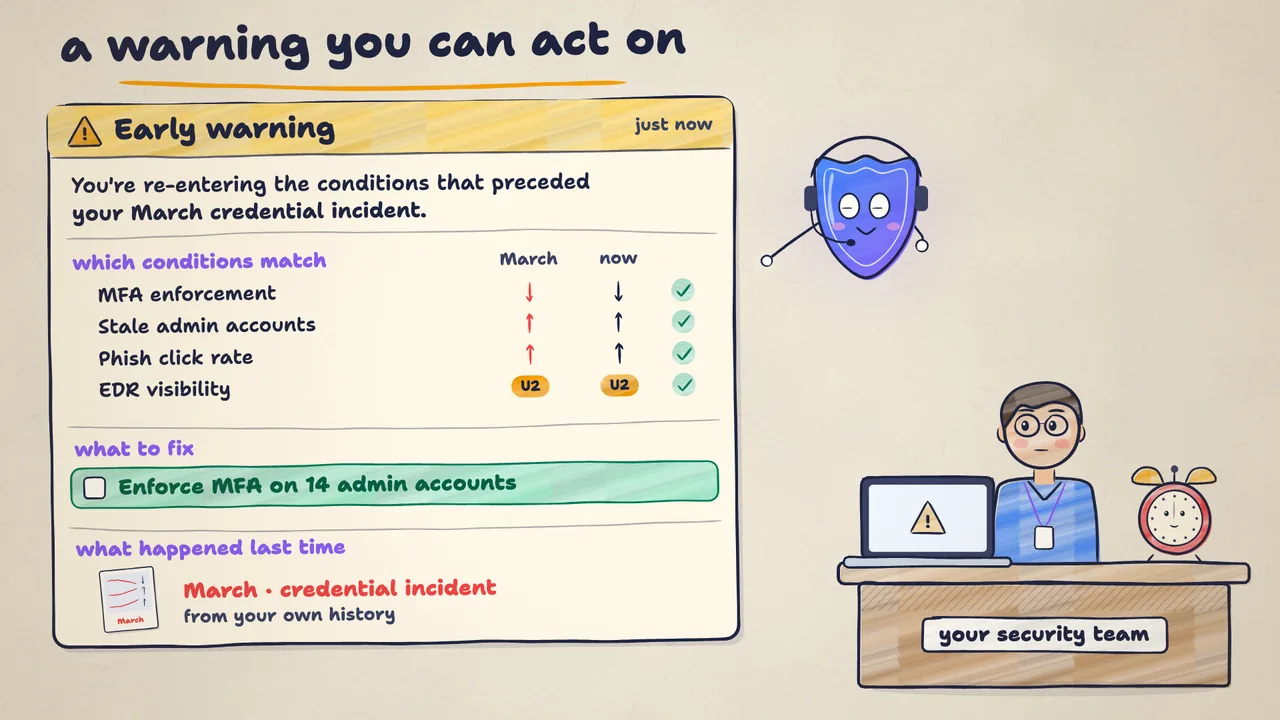
Your controls are drifting right now, and most platforms won’t tell you until something breaks. Draxis catches the trend before it becomes the failure, and turns it into decisions your security team, your leadership, and your board can act on.
It connects to the tools you already run (EDR, SIEM, CSPM, identity, vuln scanners), pulls Key Risk Indicators continuously, and gives you a live, quantified read on your exposure: financial, operational, regulatory, reputational. Run it as a force multiplier for your CISO, or as the AI vCISO when you don’t have one.
AI vCISO · expert panel · risk simulation · MCP integration · first answer in under 48 hours
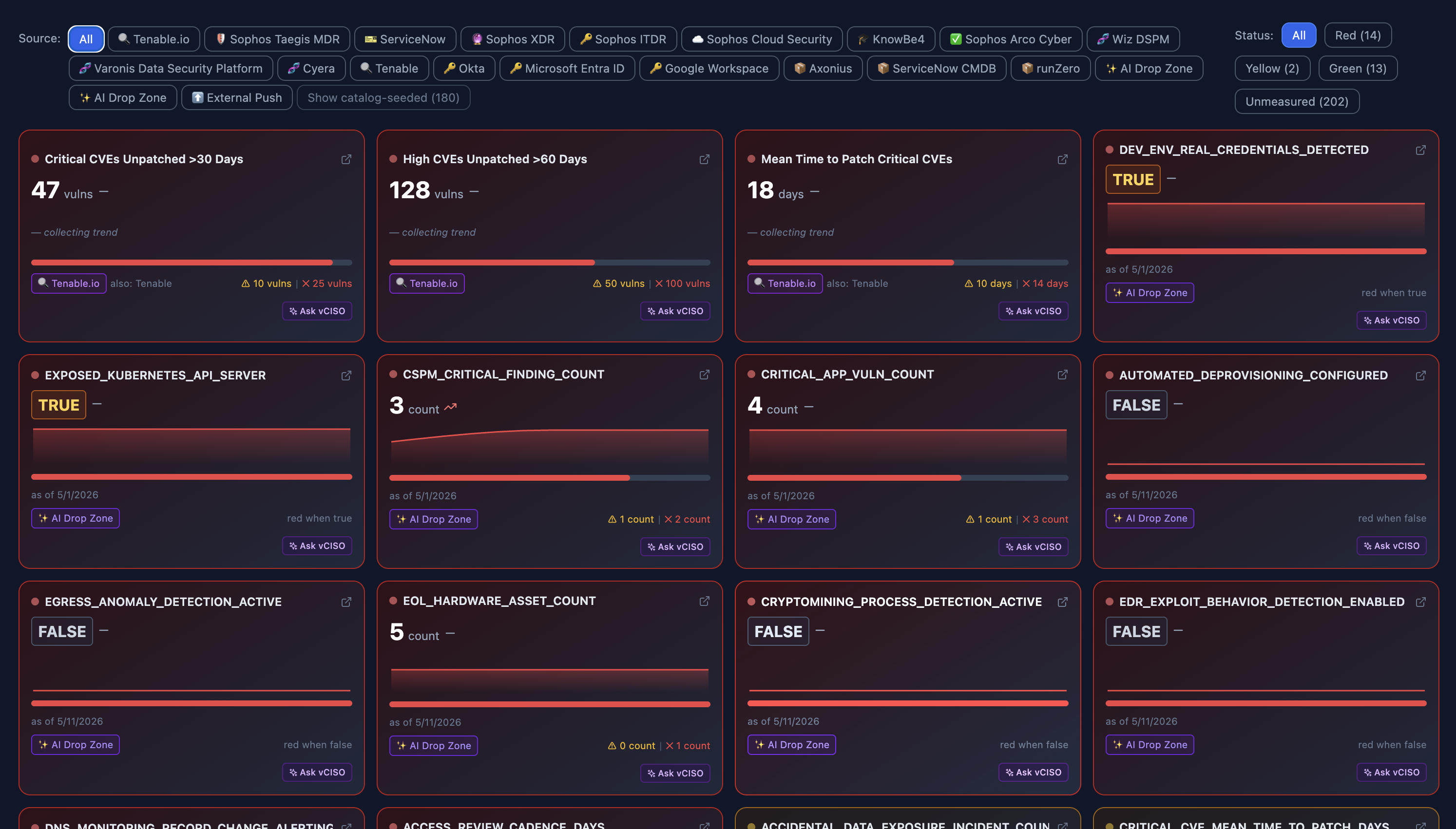
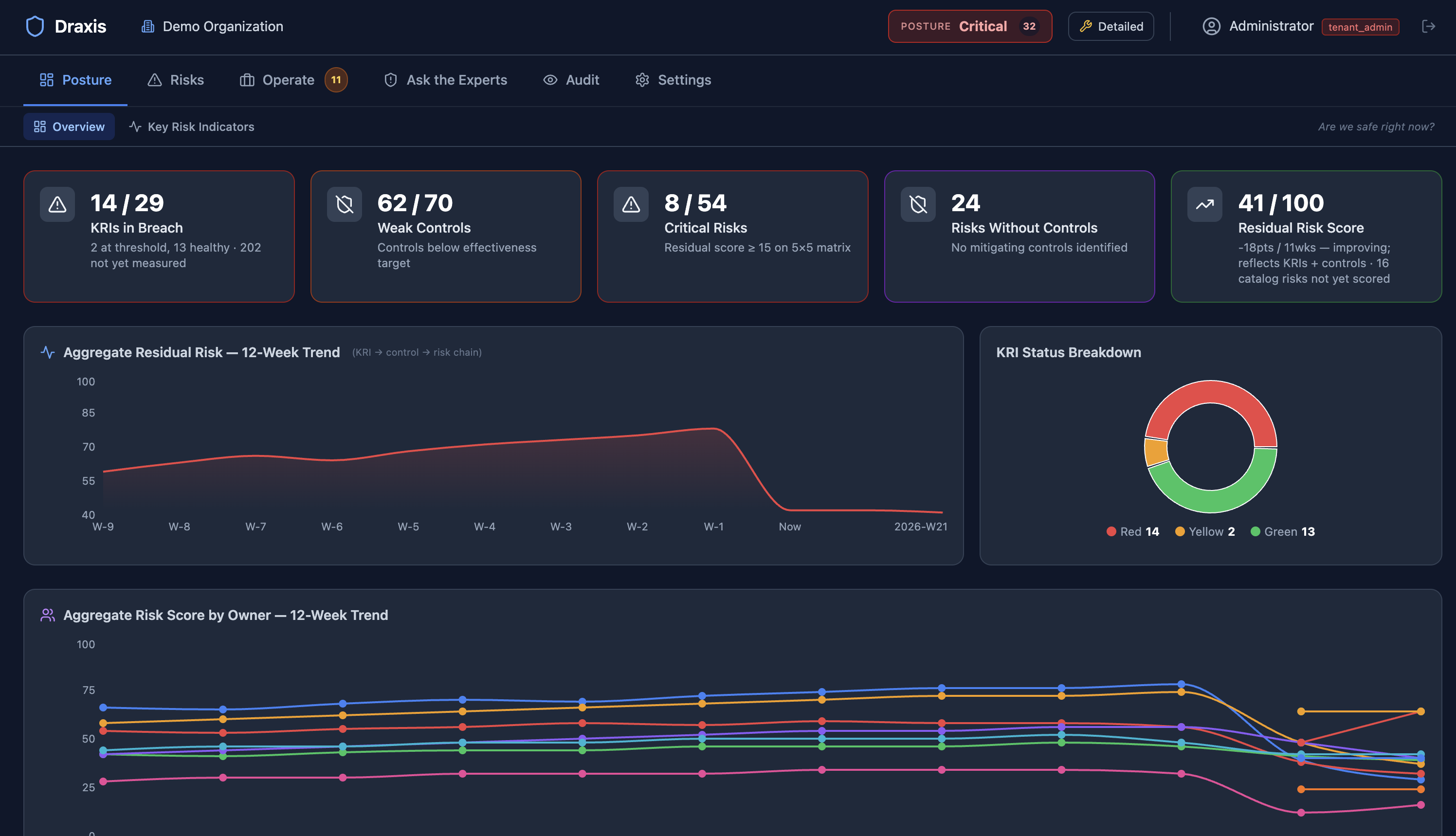
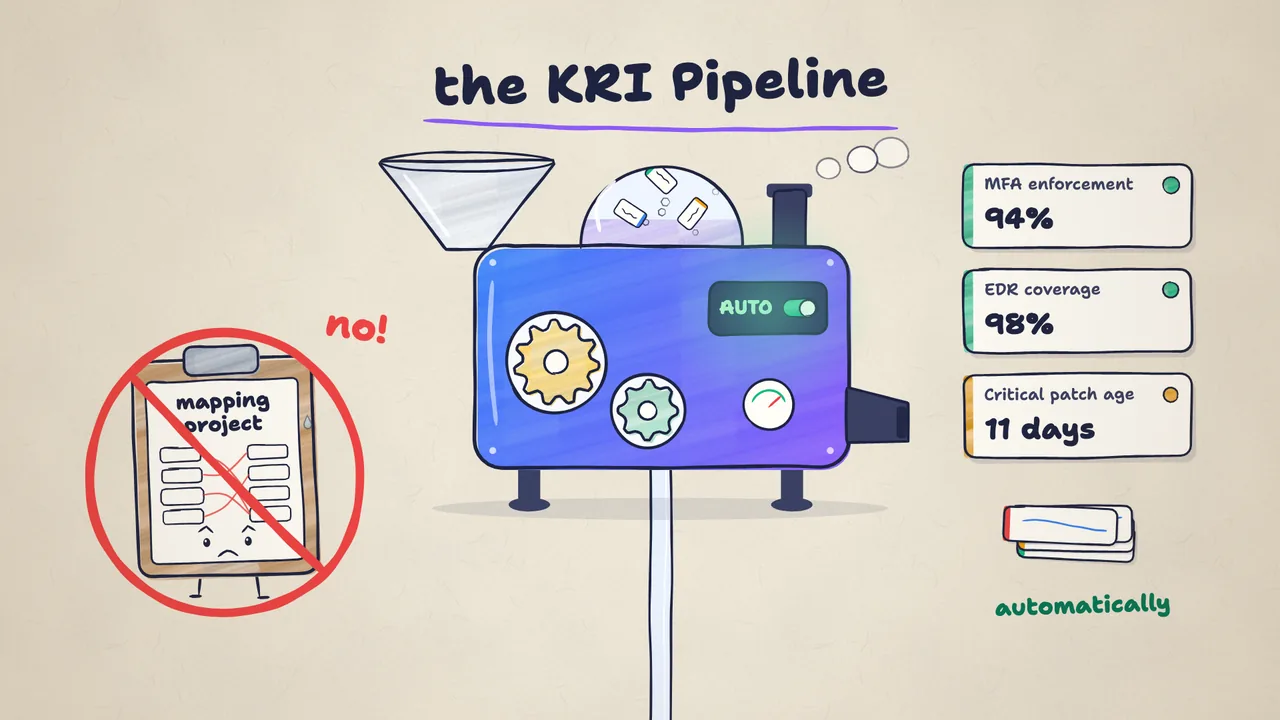
Your security tools are doing their job. Reading them isn’t happening. Your SIEM, EDR, vuln scanner, identity platform, and cloud security tools generate millions of signals a quarter. Your real risk is in there, changing every day. Your team is finding out about it in retrospect, if at all. Most platforms report on what your controls say they’re doing. Draxis reads what they’re actually doing, surfaces the actual risk picture as it changes, and catches what’s drifting before it becomes a failure.
How it works
Live risk picture in under 48 hours. Translations on demand.
Read-only API connections to your existing security stack. No agents to deploy. No new controls. No GRC checkbox busywork. The first quantified picture of your actual risk lands in days, not the quarter your last consulting engagement took. Regulator notifications, insurer submissions, and yes the board readout, all draft from that same picture instead of being separate projects.
Connect what you already run.
The problem: your control data is locked inside 10+ tools and nobody has the time to stitch it together.
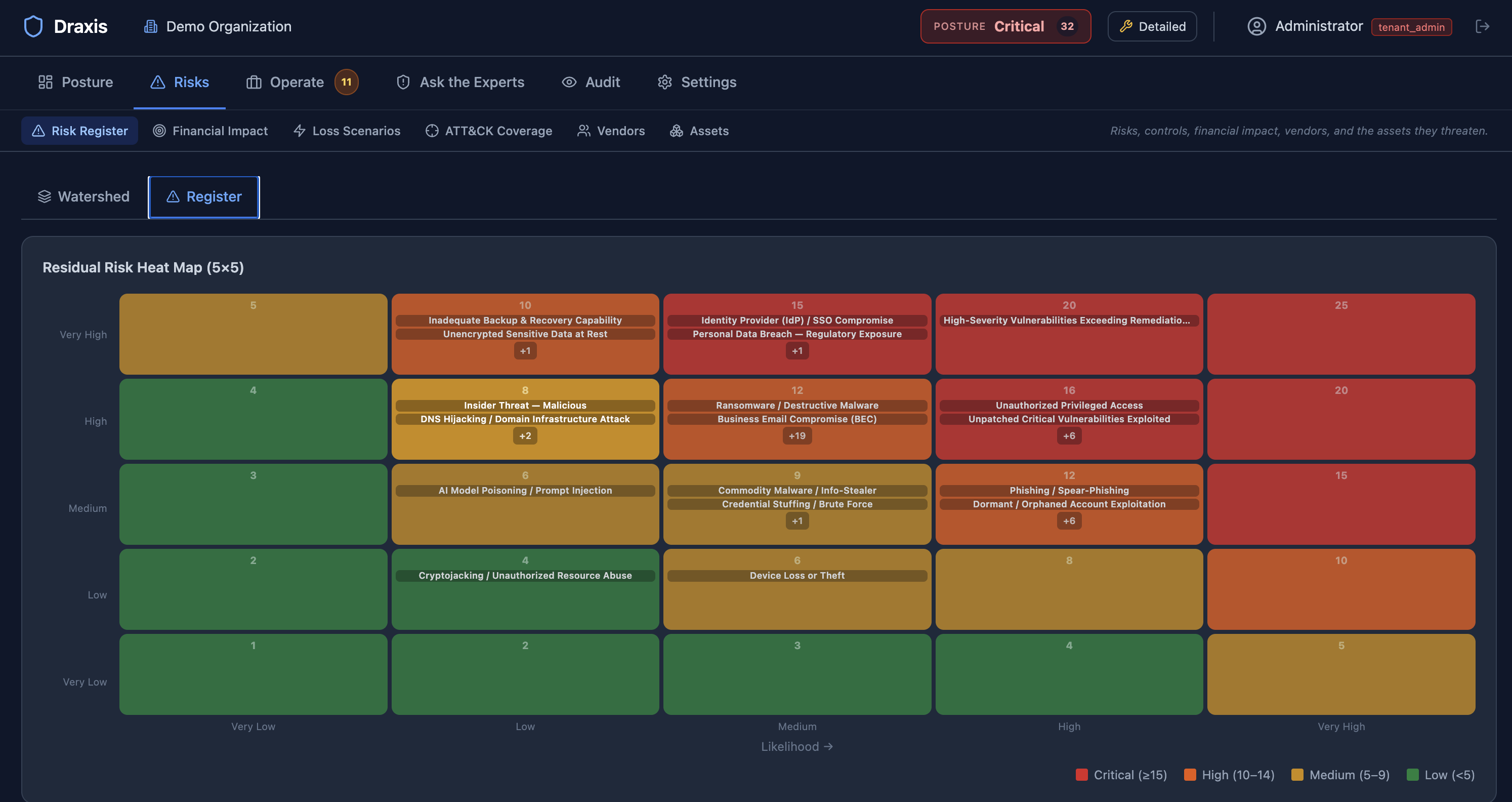
What AI does: 28 native connectors (Okta, Defender, CrowdStrike, Tenable, Splunk, AWS, GitHub, KnowBe4, and 20 more), an MCP client that ingests from any MCP-enabled tool, and a REST API fallback. For the long-tail tools without a connector, the AI Drop Zone takes whatever you can paste, drag, or push. AI auto-maps every signal into the risk catalog and populates your Risk Register on day one. No empty grids waiting on analyst configuration.
Quantify the risk that’s actually there.
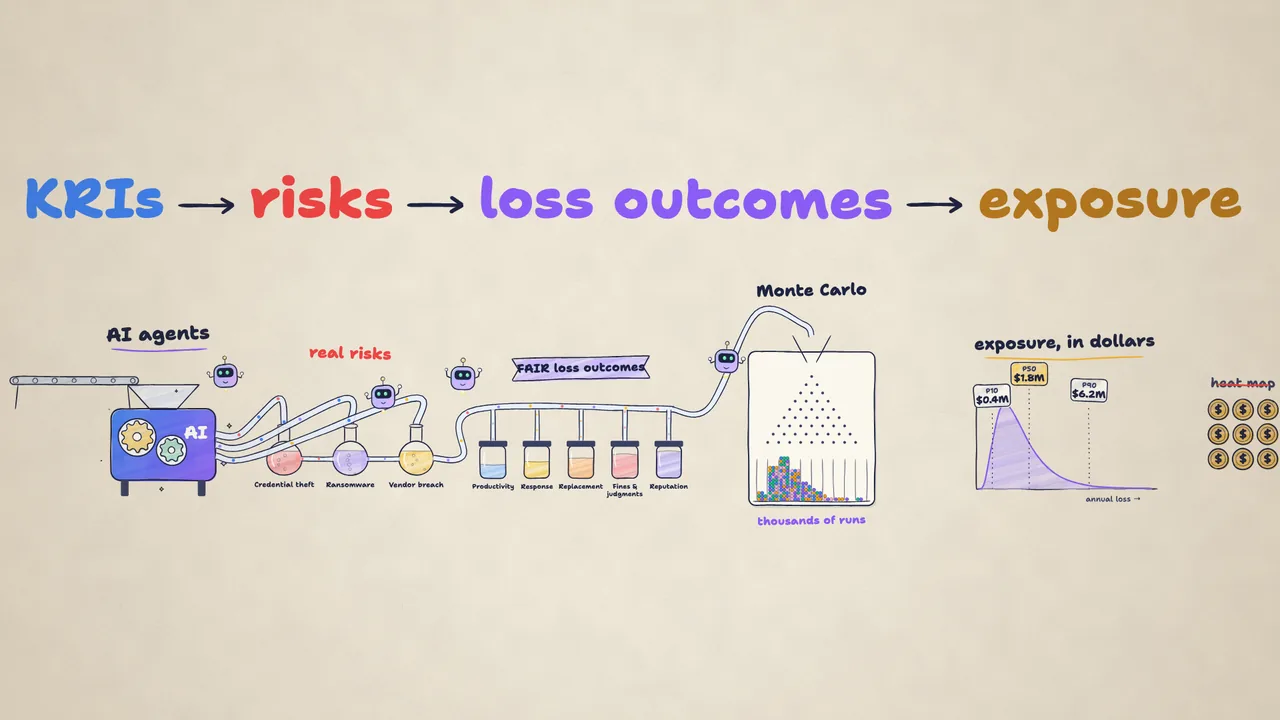
The problem: a CVE count tells your team nothing real, and tells your CFO even less. “$4.2M expected loss this quarter” is the number that moves a decision.
What AI does: the AI vCISO and expert panel reason across your live posture and quantify it across the four dimensions that matter: financial exposure, operational risk, regulatory liability, reputational impact. The picture is current today, not from your last assessment, and every value cites the signals, controls, and scenarios it was derived from.
Translate to whichever audience asks.
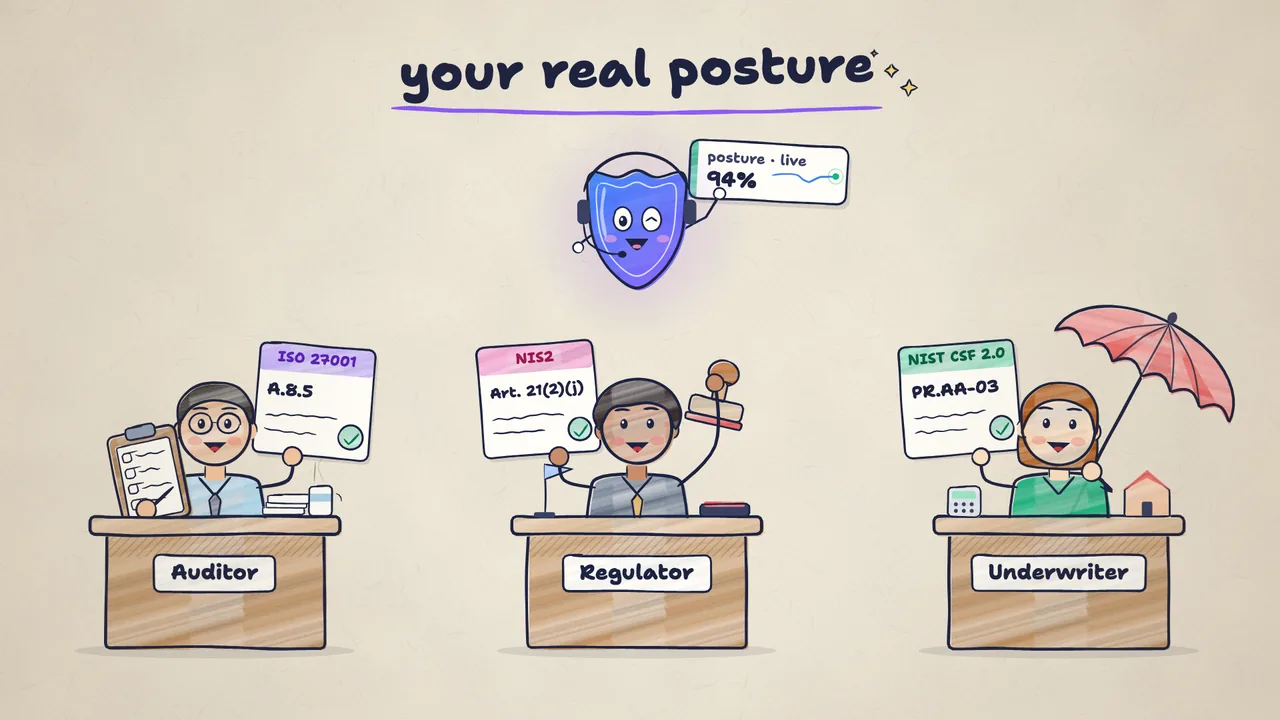
The problem: once you have the real risk picture, you still have to re-explain it for the auditor, the regulator, the cyber insurance underwriter, and yeah, the board too. By hand. Every single time.
What AI does: drafts the regulator-shaped breach notification, the underwriting narrative, and yes the board readout. All from the same live picture. Same evidence, different vocabulary for each audience. You review and ship instead of writing from scratch.
Two modes, one platform
Built for organizations with a CISO. And ones that can’t afford one.
Same AI engine, two distinct experiences. The mode is per-user, so your CFO sees plain English on the same tenant where your analyst sees the full Risk Register.
Amplify the CISO you already have
The problem: your CISO is one person trying to read every signal, run the loss math, and stay current on privacy law, third-party risk, and cyber insurance. Real-time understanding of the actual environment is the first thing that falls off the desk.
What AI does: ingests your stack continuously, runs the loss simulations, surfaces what is drifting before someone has to ask, and pulls in AI specialists in Privacy, TPRM, and Cyber Insurance on demand. Your CISO operates with a live picture instead of a quarterly snapshot, and gets the audit, regulator, and stakeholder drafts as a downstream byproduct. Detailed mode exposes the full Risk Register, KRI Board, Loss Scenarios, and Inbox.
Be the vCISO when you don’t have one
The problem: a fully-loaded CISO costs $400K+ a year. Most growth-stage and mid-market companies can’t justify the hire. They still need someone watching the environment, calling out drift, and owning the answer when an auditor, regulator, or insurer asks.
What AI does: the AI vCISO becomes your CISO function. Continuous monitoring of your actual stack, investment guidance grounded in your real exposure, and the experienced perspective of a seasoned operator. Without the salary. Simple mode shows your CFO a single GOOD / WATCH / URGENT screen and an “Ask vCISO” panel. No jargon, no KRI, no MITRE, no CVE acronyms.
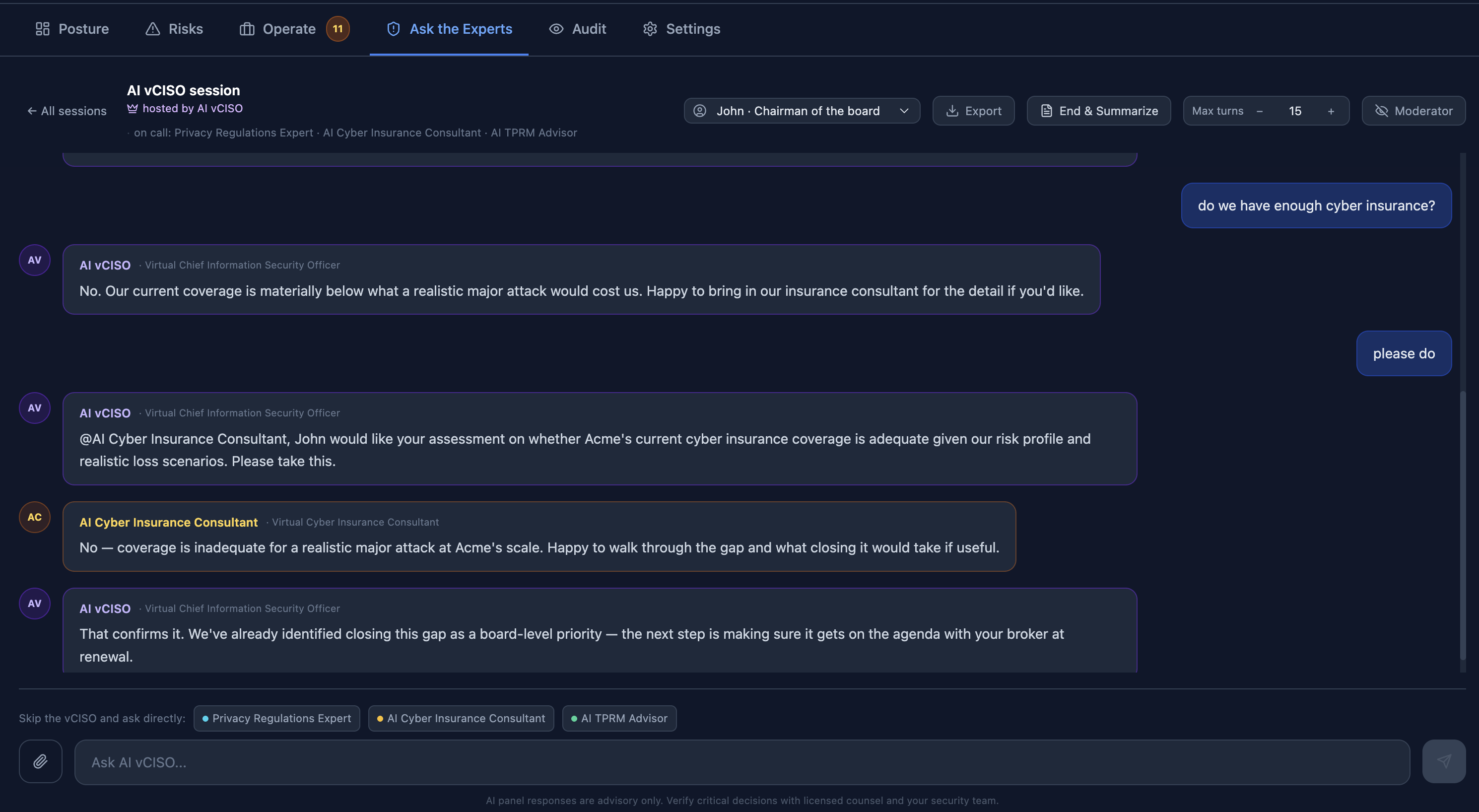
The vCISO-led AI expert panel
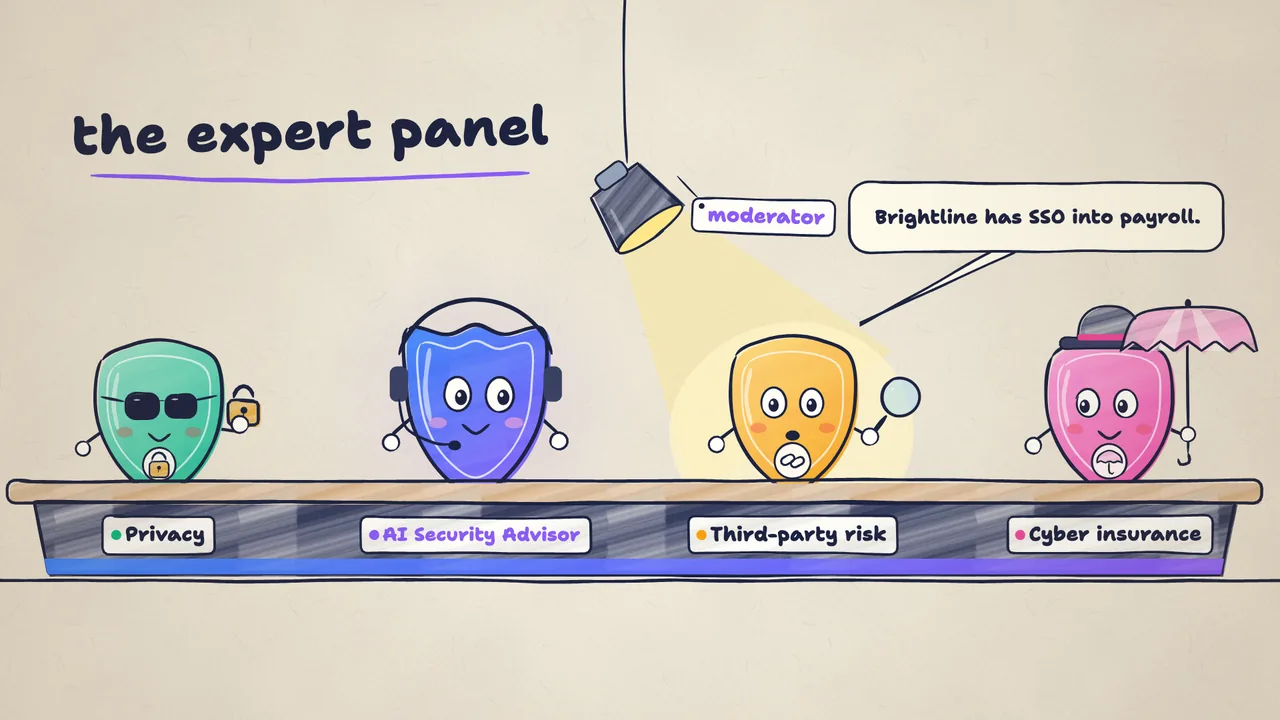
You only ever talk to the vCISO. It brings in the right specialist for you.
Cyber risk decisions touch privacy law, third-party risk, and insurance. Few CISOs are deep in all three. The AI vCISO opens every conversation, asks the right questions, and routes the discussion to the specialist that can answer them. You never have to know who to ask. Every answer is grounded in your live risk posture, not generic advice.
The CISO voice that knows your environment
- Solves: “our CISO has no time to keep up with what just changed in our stack”, or “we don’t have a CISO at all”
- Continuous risk-posture briefings tied to financial loss potential, refreshed as your stack changes
- Drafts strategy memos, investment cases, trend deltas, and yes board readouts when those are needed
- Per-stakeholder memory: CFO answers and CISO answers diverge by framing, grounded in the same evidence
The privacy counsel you didn’t hire
- Solves: SEC Cyber Rules, DORA, NIS2, GDPR, CCPA, HIPAA, NYDFS. Nobody on staff owns all of it.
- Maps your live posture to what each regulator requires
- Drafts regulator-shaped breach notifications from real evidence
- Stays current as regulations change. No code release needed.
Vendor risk from your stack, not questionnaires
- Solves: “our vendor questionnaires are self-attestation theater”
- Vendor concentration risk, supply-chain gaps, and fourth-party exposure, derived from your existing stack
- Detects drift between what a vendor attests and what your telemetry shows
- Tailored for the CRO and the security lead who own vendor risk
Turns posture into premium leverage
- Solves: “our renewal questionnaire is a guess and our premium reflects that”
- Maps loss scenarios to your actual policy language
- Surfaces control gaps that move underwriting outcomes
- Drafts the renewal narrative your broker can put in front of the carrier
AI across the platform
Every painful step in a risk program. AI does the lifting.
Each surface below replaces a specific manual job that used to need an analyst, a consultant, or a quarter you didn’t have. Together they cover what a real cyber risk program does, end to end: ingestion, scoring, simulation, and reporting.
Tools without a connector still land risk signal.
- Solves: long-tail tools with no native integration go invisible to your risk program
- Drag a PDF, paste a CSV, push a webhook. AI extracts typed Key Risk Indicators against the catalog.
- Pentest reports, vendor SOC 2s, audit notes, log snapshots, config exports, screenshots
- Every value cites its source span. High-confidence extractions auto-accept, the rest queue for review.
Connect a new tool. Your Risk Register populates itself.
- Solves: “I plugged in EDR and the Controls list is still empty”
- When you add an integration, AI fills the catalog gaps (signals → safeguards → controls → ATT&CK techniques) within seconds
- Your Risk Register’s Controls list goes from empty to populated in 5–15 seconds, not weeks of analyst configuration
- Low-confidence proposals queue in the Inbox so analysts review instead of author from scratch
No more default 3×3 heat map.
- Solves: a brand-new tenant where every catalog risk sits at the default until an analyst configures all 42
- At onboarding and on every connector save, AI proposes per-tenant likelihood and impact based on your industry, headcount, KRI mix, and control density
- High-confidence scores apply automatically. The rest queue with reasoning for your analyst to tweak in seconds.
- AI never overwrites a human-set value. Provenance is tracked per score.
You see the risk. AI tells you what to install.
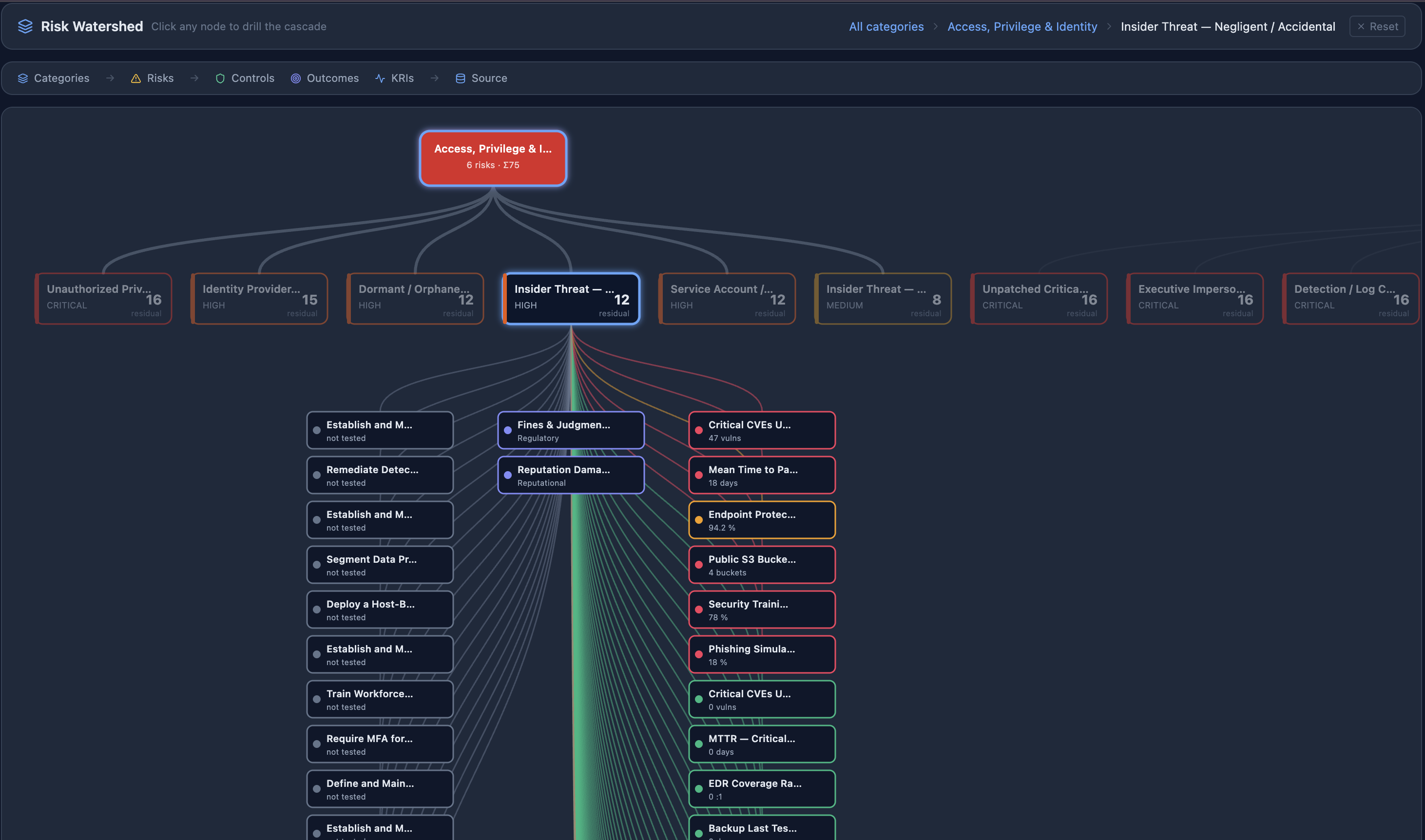
- Solves: “I see this risk on the heat map. I have no idea what control would actually move it.”
- For every catalog risk, AI surfaces the CIS Controls v8 safeguards that should govern it, not only the ones wired today
- Names the connectors and signals that would measure each one (e.g. Require MFA for Admin Access · measured by Okta, Entra, Google Workspace)
- One-click path: I see the risk → I know what should govern it → I know what to install
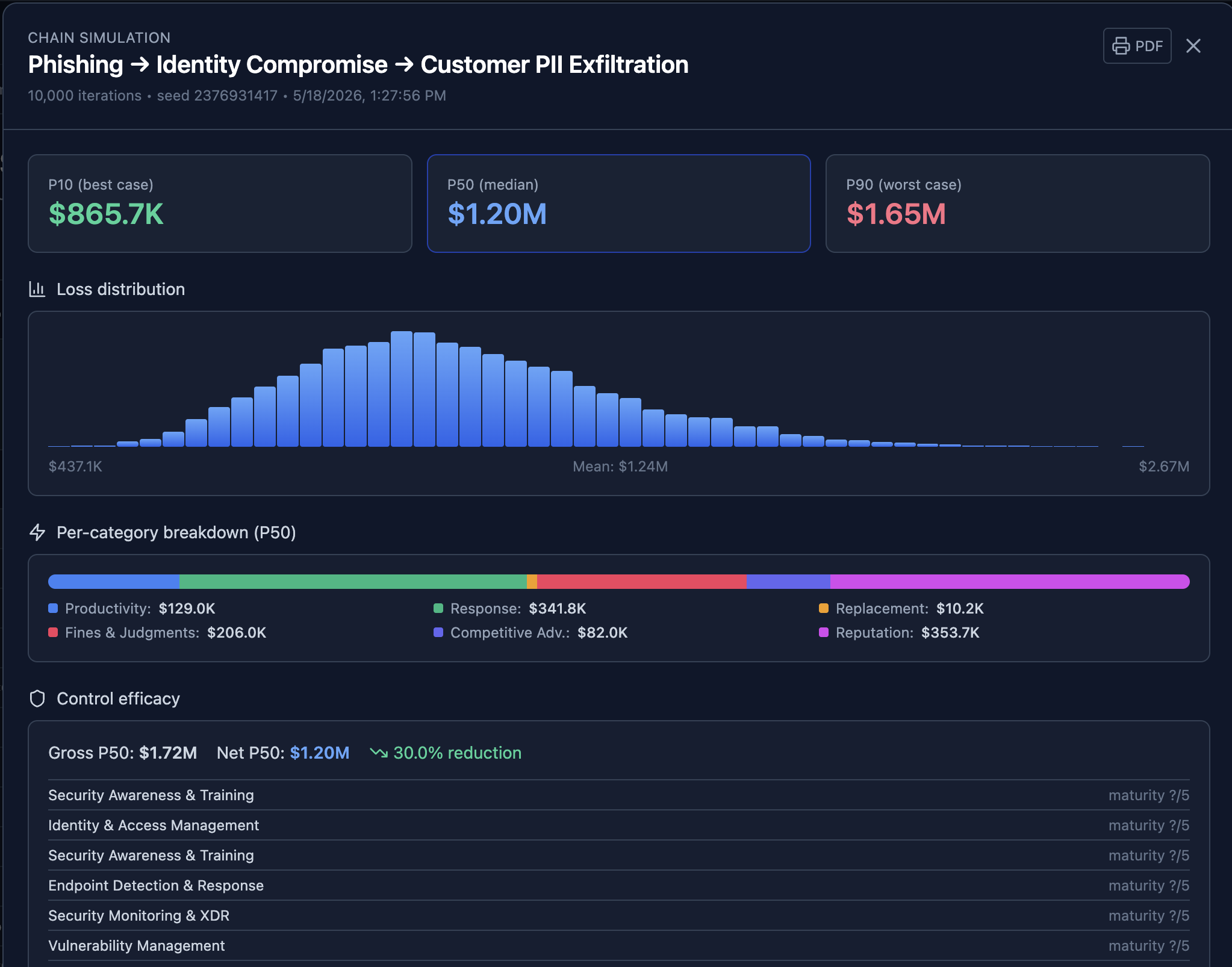
Quantify scenarios in dollars, not vibes.
- Solves: “we have no idea what a ransomware event would actually cost us, in dollars, given our real asset and identity inventory”
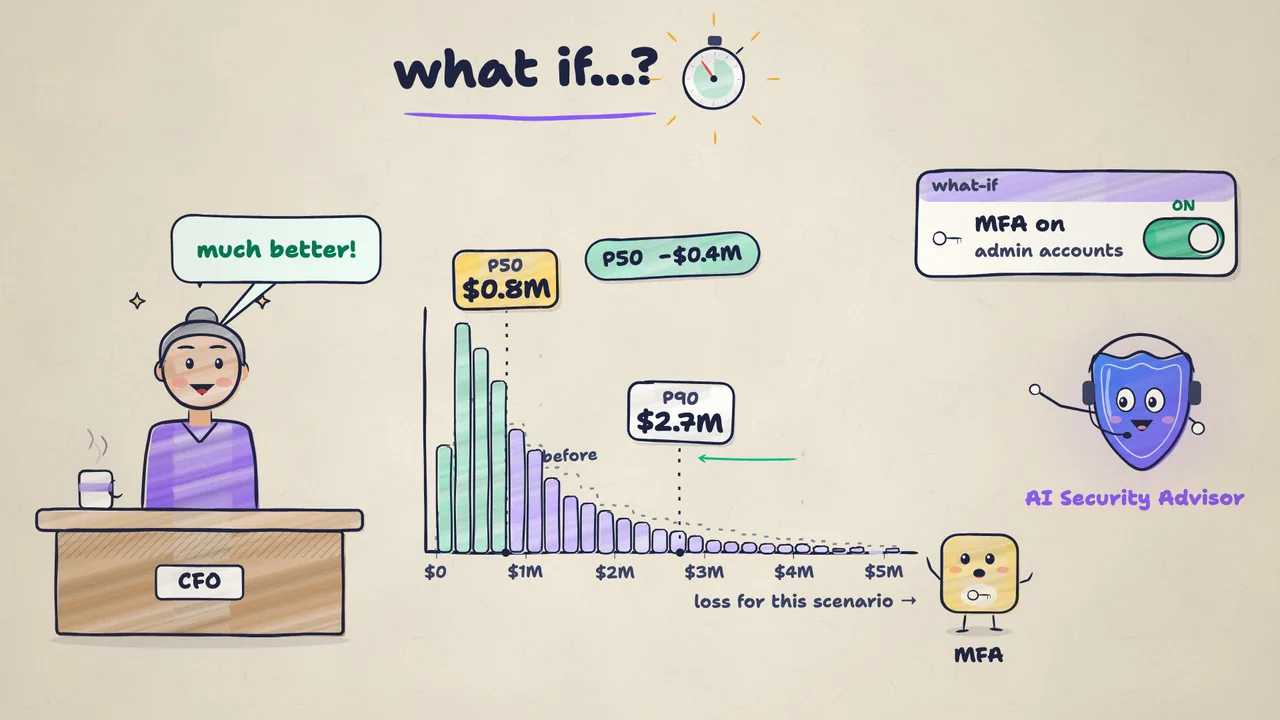
- Monte Carlo loss scenarios grounded in your real asset, identity, and data inventory, with P10 / P50 / P90 outputs
- Multi-step attack chains, blast-radius graphs, toxic-combination detection
- Counterfactuals: “what if we added MFA on this asset class?” runs instantly with the dollar delta
- Regulatory fines modeled directly (GDPR, CCPA, HIPAA, PCI-DSS, state breach laws)
Your risk catalog stays current automatically.
- Solves: “new threats land every day; my risk register is from last year”
- Daily threat-intel sweep (CISA KEV today; ENISA + MITRE ATT&CK on roadmap) plus tenant-drift detection
- AI proposes catalog additions, applicability filtering keeps narrow CVEs out of your queue
- Approved updates ship to every tenant on next sync, so you inherit the catalog work everyone else triggered
Your policy, mapped to your real risk.
- Solves: “our renewal premium is going up and we don’t know which controls would move it”
- Upload the policy. AI maps coverage against your live posture and identifies gaps and over-insured areas.
- Translates loss scenarios into expected indemnity against your specific sublimits and exclusions
- Drafts the renewal narrative your broker can put in front of the carrier
Universal AI integration
Universal AI integration. Every direction.
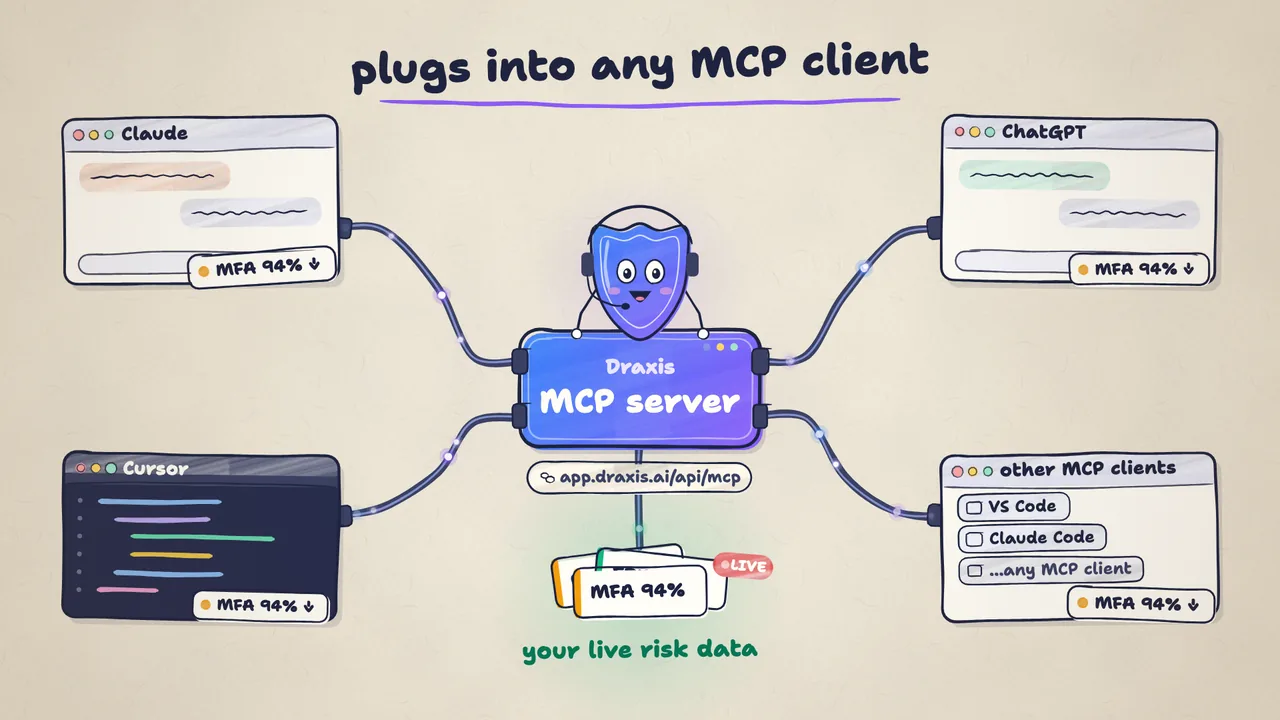
Draxis connects to your stack three ways, and all three are universal. It reads from your tools, it answers from any AI client, and the rest lands through the Drop Zone.
Ingest from any MCP-enabled tool
Draxis ingests from any tool that exposes an MCP server. As more tools adopt MCP, every new one becomes a native integration automatically. No custom connector to build.
Universal fallback, any tool, any format
For everything without a connector yet, the REST API and the AI Drop Zone take whatever you have. Paste a CSV, upload a log, POST a webhook, and AI extracts the signal.
Query Draxis from any LLM client
Any LLM client queries Draxis directly. Ask your live risk posture anything from Claude, ChatGPT, or any MCP-compatible AI client, and get an answer drawn from your real environment.
Generate board-deck narratives straight from PowerPoint, drawn from your live posture.
Ask your live control signals anything from your LLM client of choice.
Fill out cyber insurance applications using live Draxis posture data.
Connect any MCP-enabled AI agent or workflow to your security intelligence.
28
Integrations supported today
MCP
Server + client, both universal
180
KRI signals across 10 domains
100%
NIST CSF coverage from day one
Compounding learning
Worth more in month 12 than in month 1.
Every conversation, decision, and signal becomes part of your tenant’s memory. And the platform itself gets sharper as more organizations join.
Your AI starts to sound like it actually works there.
Every Drop Zone extraction, AI vCISO answer, panel deliberation, and risk decision is captured as institutional memory, with provenance. Future answers get framed against your baseline, your conventions, your prior reasoning. Not an industry average. Not a generic prompt.
A Draxis instance that’s been live for a year is materially smarter about your business than any consultant can be on day one.
AI-first by design. Not AI bolted on after the fact.
Draxis sits in a category that didn’t exist five years ago: cyber risk intelligence. It is not a GRC tool. It is not a vulnerability scanner. It is not an external attack-surface score. It is not a SIEM. It assumes your controls already exist, reads what they’re saying, and translates it into business risk. The AI architecture (ingestion, reasoning, simulation, learning) was the starting point, not a feature pile-on.
If you already use Vanta, Drata, Bitsight, or SecurityScorecard: good. Draxis reads from them and turns the output into a live, quantified picture of your real exposure. We’re complementary, not competitive.
Who it’s for
If your last 90 days included one of these,
you’re who Draxis is built for.
Cyber insurance renewal. SEC, DORA, or NIS2 filing. The board asked for a cyber risk briefing. A peer in your industry got breached. A new privacy law shipped. You’ve been asked to answer one of those without a CISO, or with a CISO who has no time to translate.
$50M–$1B revenue, 200–2,000 employees
You’ve got the security stack (EDR, SIEM, identity, vuln scanning) and a security manager or fractional CISO who doesn’t have time to keep a real-time read on what it’s saying. AI does the reading: continuous KRI extraction, dollar-quantified scenarios, and the audit, regulator, and board drafts whenever you need to ship one. Whether you have a CISO or not.
vCISOs and advisory firms
You can’t manually keep a live read on ten clients’ environments and still have time to advise them. AI does the reading, the reasoning, and the drafting. Each client tenant gets sharper week over week. You bill more clients without billing more hours.
See the vCISO program →MSPs and MSSPs
Your managed security stack protects clients. AI tells them what their protection is actually worth in operational, financial, and insurer terms. White-label at the Enterprise tier. A defensible, recurring service layer on top of what you already deliver, instead of another commoditized line item.
See the MSP program →Decision-makers on the hook for the answer
You’re the one expected to know what your real exposure is right now, and to answer the auditor, the regulator, the insurer, and yes the board when they ask. AI gives you the live picture continuously, plus drafts of the same evidence in each audience’s vocabulary. Cited, defensible, continuously refreshed. Stop being the human translation layer.
Pricing
Simple, transparent pricing
that scales with you
- 1 organization (add business units at $500/mo each)
- Full expert panel: AI vCISO, Privacy, TPRM, Cyber Insurance
- 28 integrations (native + MCP + REST)
- Continuous risk intelligence for your team, your insurer, and stakeholders on demand
- MFA enforcement + immutable audit logs
- Board-ready risk narratives and trend deltas
- Requires existing security stack
- 10–49 client tenants (Practice tier)
- Multi-tenant dashboard across every client
- Co-branded / white-label client reporting
- AI expert panel with per-client institutional memory
- Partner Slack channel + priority support
- Volume tier economics on every billed tenant
- Unlimited tenants
- SSO (SAML / OIDC)
- Unlimited expert panel queries
- White-label for MSSPs
- Dedicated infrastructure
- Custom integrations & API
- Carrier-grade policyholder API (available)
- Priority support & SLA
Draxis is designed for organizations with an existing security stack. A minimum maturity threshold applies: you need active controls and integrations for the platform to deliver meaningful signal. If you’re building your first security program, we can point you to the right resources first.
Enterprise-Grade Security
Built for trust
from day one
- ✓ JWT RS256 with auto-rotating refresh tokens
- ✓ TOTP MFA with encrypted secrets & backup codes
- ✓ Four-tier RBAC (Super Admin → Viewer)
- ✓ Per-tenant database isolation (physical separation)
- ✓ Immutable audit logging for all security events
- ✓ HttpOnly cookies with CSRF protection
- ✓ Rate limiting on authentication endpoints
- ✓ SSO-ready architecture (SAML 2.0 / OIDC)
- ✓ Secure SDLC with AI-powered code scanning & blocking
- ✓ Vulnerability Disclosure Policy (RFC 9116)
Support & Documentation
Everything you need to connect Draxis to your stack: integration guides, API reference, architecture overviews, and direct access to the team.
Multi-Tenant SaaS Architecture
Database-per-tenant model ensures complete data isolation. Central registry manages tenant lifecycle. Stateless JWT enables horizontal scaling.
Tech Stack
See your actual risk, live, by the end of the week.
Connect a few read-only APIs. Within 48 hours you’ll have a populated Risk Register, dollar-quantified loss scenarios, and a live picture of your real exposure. The regulator notification, the insurance posture read, and the board readout all draft from that same picture, on demand. No agents. No GRC checkbox work. No rearchitecting.